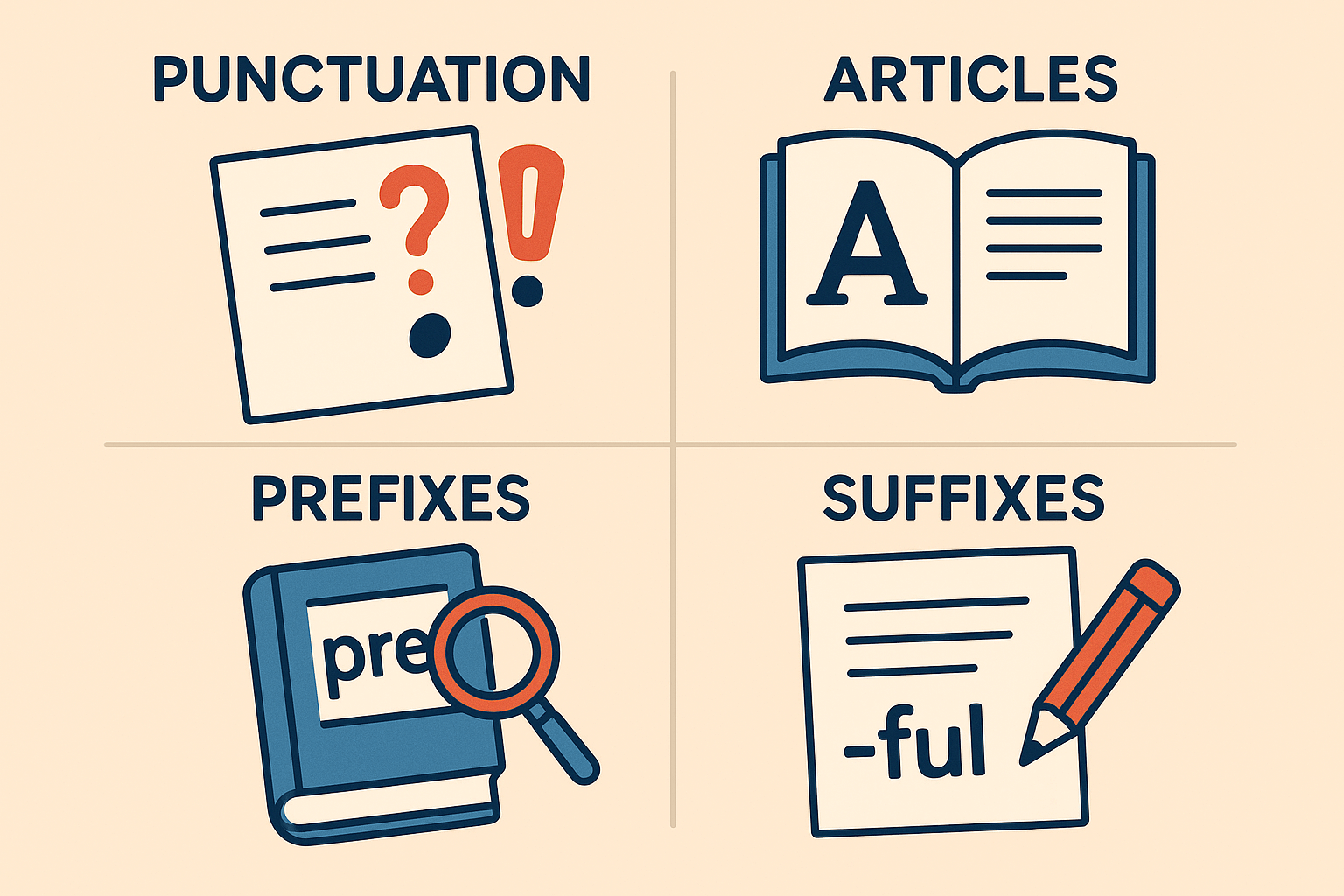
Effective writing and speaking in English depend not only on choosing the right words but also on using small units of language—punctuation marks, articles, prefixes, and suffixes—to signal meaning, nuance, and structure. In this comprehensive guide, we’ll explore how these elements work, common pitfalls to avoid, and practical tips to help you write with precision and confidence.
The Power of Punctuation
Punctuation marks are the road signs of written language. They guide the reader through the text, indicate pauses, clarify relationships between ideas, and convey tone.
Periods, Question Marks, and Exclamation Points
Periods (.) end declarative sentences and indirect questions. Question marks (?) follow direct questions. Exclamation points (!) add emphasis or express strong emotion.
Examples
• She finished her report on time.
• Did you complete the assignment?
• That was incredible!
Tip: Use exclamation points sparingly in formal writing to maintain professionalism.
Commas
Commas (,) separate elements in a list, join independent clauses with coordinating conjunctions, set off introductory elements, and enclose nonessential information.
Examples
• I bought apples, oranges, and grapes.
• She studied hard, but she still felt nervous.
• After the meeting, we went for coffee.
• My brother, who lives in Sydney, is visiting next week.
Tip: Avoid comma splices by using a comma and coordinating conjunction or replacing the comma with a semicolon.
Semicolons and Colons
Semicolons (;) link closely related independent clauses or separate items in a complex list. Colons (:) introduce lists, quotations, or explanations.
Examples
• She loves reading; he prefers watching movies.
• Three candidates applied: an engineer, a designer, and a marketer.
• He faced one obstacle: lack of funding.
Tip: Use a semicolon instead of a period when you want to highlight the relationship between two sentences.
Apostrophes
Apostrophes (’) show possession and form contractions.
Possession
• Singular: the student’s notebook
• Plural: the students’ lounge
Contractions
• do not → don’t
• it is → it’s
Tip: Never use an apostrophe to pluralize a noun (e.g., “apple’s” for more than one apple is incorrect).
Quotation Marks and Italics
Quotation marks (“ ”) enclose direct speech, titles of short works, or words used in a special sense. Italics can be used for emphasis, titles of longer works, or foreign words.
Examples
• She said, “Let’s begin.”
• I just finished reading To Kill a Mockingbird.
• The word schadenfreude comes from German.
Tip: In British English, single quotation marks are more common for quotations.
Parentheses, Brackets, and Dashes
Parentheses (()) add supplementary or tangential information. Brackets ([]) are used within quotations to clarify or correct. Dashes (– or —) create a strong break in thought or set off parenthetical elements.
Examples
• He finally answered (after much deliberation) that he would attend.
• “He [the mayor] declined to comment.”
• Everything I saw—the museum, the gardens, the waterfront—was breathtaking.
Tip: Use em dashes (—) for emphasis or interruption, but avoid overuse to maintain readability.
Mastering Articles: “A,” “An,” and “The”
Articles are small but essential words that introduce nouns and specify whether they are definite or indefinite.
Indefinite Articles: “A” and “An”
“A” and “an” signal nonspecific singular nouns. Use “an” before vowel sounds and “a” before consonant sounds.
Examples
• a book, a university (pronounced “yoo”), a European country
• an apple, an honor (silent “h”), an MBA
Tip: Focus on pronunciation rather than spelling to choose between “a” and “an.”
Definite Article: “The”
“The” refers to specific or previously mentioned nouns, singular or plural.
Examples
• The book on the table is mine.
• I saw the movies you recommended.
Tip: Omit “the” before general, abstract, or uncountable nouns when speaking broadly (“Life can be unpredictable,” not “The life can be unpredictable”).
When to Omit Articles
No article is needed before:
• Proper nouns (Australia, John)
• Names of meals, languages, sports (breakfast, English, tennis)
• Plural nouns when speaking generally (Cars can be expensive)
• Uncountable nouns when speaking generally (Information is valuable)
Tip: Practice by reading sentences aloud and listening for whether the noun sounds specific or general.
Building Meaning with Prefixes
Prefixes are letters or groups of letters added to the beginning of a root word to alter its meaning. Learning common prefixes expands your vocabulary and helps you infer the meaning of new words.
Negative and Reversal Prefixes
• un- (unhappy, unlock)
• in-/im-/il-/ir- (incomplete, impossible, illegal, irregular)
• dis- (disagree, disconnect)
Degree and Quantity Prefixes
• re- (redo, rewrite)
• over- (overload, overreact)
• under- (underestimate, underperform)
Time and Order Prefixes
• pre- (preview, preheat)
• post- (postpone, postgraduate)
• pro- (proactive, prologue)
Relationship and Position Prefixes
• inter- (international, interact)
• sub- (submarine, subway)
• super- (superhuman, supermarket)
Tip: When you encounter an unfamiliar word with a prefix, separate the prefix and root to unlock its meaning.
Enhancing Vocabulary with Suffixes
Suffixes are letters or groups of letters added to the end of a root word. They often change the part of speech or nuance of the original word.
Forming Nouns
• -ness (happiness, darkness)
• -tion/-sion (creation, decision)
• -er/-or (teacher, actor)
• -ity (reliability, creativity)
Forming Adjectives
• -able/-ible (readable, audible)
• -ful (beautiful, careful)
• -less (hopeless, effortless)
• -al (natural, regional)
Forming Adverbs
• -ly (quickly, happily)
• -ward/-wards (forward, backwards)
Forming Verbs
• -ize/-ise (realize, organise)
• -en (widen, strengthen)
Tip: Pay attention to spelling changes when adding suffixes (e.g., drop the silent “e” in “hope” to form “hopeless”).
Common Pitfalls and How to Avoid Them
Overusing Punctuation Marks
Too many commas or exclamation points can clutter your writing. Keep punctuation purposeful and clear.
Article Confusion
Non-native speakers often omit or misuse articles. Practice with exercises that require you to fill in “a,” “an,” or “the” in context.
Prefix and Suffix Spelling Errors
Watch for doubled letters and silent “e” rules. Keep a reference list of common affixes to reinforce correct spelling.
Misplaced Affixes
Ensure prefixes and suffixes attach to the correct root. Avoid creating unnatural words (e.g., “unpossible” instead of “impossible”).
Practical Strategies for Mastery
Read widely and note examples of punctuation, article usage, and affixes in context. Use flashcards to memorize common prefixes and suffixes. Write short paragraphs focusing on one element at a time—punctuation accuracy, article precision, or affix application—and review with a grammar tool or peer feedback. Engage with targeted exercises in OwnFluent’s Grammar Ace module for customized practice and instant feedback.
Mastering these small but powerful components of English will transform your writing and speaking, making your messages clear, sophisticated, and engaging. Ready to perfect your punctuation, articles, prefixes, and suffixes? Try OwnFluent’s Grammar Ace today and experience personalized guidance every step of the way.