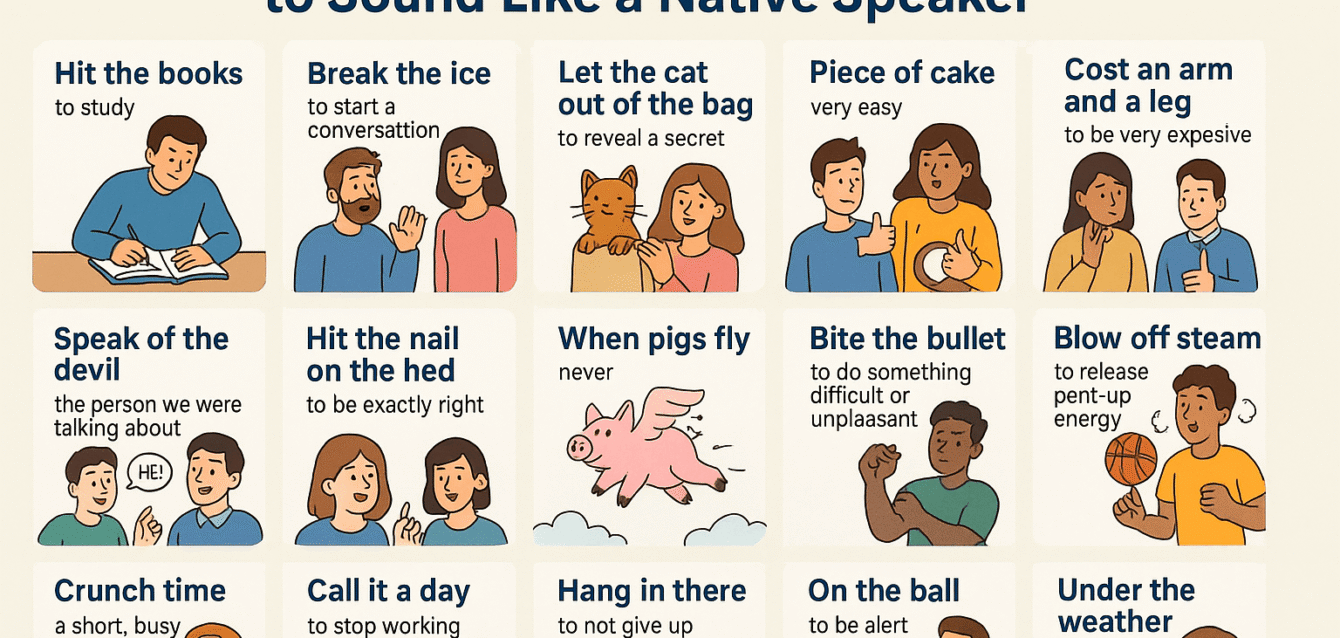
Idioms are the colorful threads that weave authenticity into your English – and nowhere is this truer than in U.S. English. By incorporating common American idioms into your speech and writing, you’ll not only sound more natural, but you’ll also gain cultural insight into how native speakers think and communicate. In this in-depth guide, we’ll explore 15 essential American English idioms, dive into their origins, offer usage tips, and suggest practice activities – so you can start speaking like a native today.
Why American Idioms Matter for English Learners
- Boost Fluency & Confidence: Idioms convey complex ideas in just a few words. Mastering them lets you express yourself more succinctly and confidently.
- Unlock Cultural Nuance: Many idioms are tied to historical events, pop culture, or everyday life in the U.S. Learning them gives you a window into American values and humor.
- Improve Listening Comprehension: Whether you’re watching Netflix, listening to podcasts, or chatting with colleagues, idioms pop up everywhere. Recognizing them prevents confusion and helps you follow conversations.
- Stand Out in Writing & Speech: Using idioms correctly adds flair and professionalism – whether you’re crafting an email, giving a presentation, or networking.
1. Break the Ice
Meaning & Origins
To break the ice means to do or say something that relieves tension and opens up conversation. The phrase goes back to the 17th-century practice of ships breaking ice in harbors to allow passage, symbolizing an initial action that makes further interaction possible.
Usage Tips
- Social Settings: Perfect for networking events, first dates, or team meetings.
- Tone: Lighthearted – often preceded by a humorous comment.
- Variations: Get the ball rolling (start something); open the floor (invite discussion).
Examples
• To break the ice at the new-hire lunch, Maria asked everyone to share their favorite movie.
• He told a funny anecdote to break the ice before the client presentation.
2. Piece of Cake
Meaning & Origins
Describing something as a piece of cake means it’s very easy. The expression likely comes from 19th-century British cakewalk competitions, where participants danced for prizes – making a piece of cake something enjoyable and effortless.
Usage Tips
- Informal Contexts: Best used in casual conversations or emails.
- Tone: Conversational – avoid in very formal reports.
- Synonyms: A breeze, easy as pie.
Examples
• That vocabulary quiz was a piece of cake – I aced it!
• Learning phrasal verbs can be tricky, but with the right practice it becomes a piece of cake.
3. Spill the Beans
Meaning & Origins
To spill the beans is to reveal a secret or surprise. Its origin is debated, but one theory ties it to early voting methods where beans were used to cast secret ballots – spilling them would reveal the results prematurely.
Usage Tips
- Warnings & Teasers: Commonly used to caution someone not to reveal confidential info.
- Tone: Playful or conspiratorial.
- Related Idioms: Let the cat out of the bag (also to reveal a secret).
Examples
• We’re planning a surprise party – don’t spill the beans!
• Julie almost spilled the beans about the merger during the meeting.
4. Hit the Road
Meaning & Origins
Literally get on the road, this idiom means to leave or begin a journey. It became popular in the U.S. during the early automobile era as highways spread.
Usage Tips
- Travel & Departures: Great for road-trip talk or wrapping up visits.
- Tone: Casual and upbeat.
- Variations: On the road again, time to roll.
Examples
• It’s getting late – we should hit the road if we want to beat traffic.
• We packed the car at dawn and hit the road by 6 AM.
5. Beat Around the Bush
Meaning & Origins
Beating around the bush means avoiding the main point. It comes from medieval hunting, where beaters would flush out game by tapping around bushes – not striking directly.
Usage Tips
- Business & Negotiations: Use to prompt direct answers.
- Tone: Slightly critical – use tactfully.
- Opposite: Get straight to the point, cut to the chase.
Examples
• Stop beating around the bush – what do you really think of the proposal?
• She beat around the bush for five minutes before admitting she’d lost the files.
6. Costs an Arm and a Leg
Meaning & Origins
When something costs an arm and a leg, it’s extremely expensive. The phrase likely emerged after WWII, reflecting the high human costs – though its literal origin is unclear.
Usage Tips
- Shopping & Budgeting: Emphasize sticker-shock moments.
- Tone: Informal – often hyperbolic.
- Synonyms: Break the bank, through the roof.
Examples
• That limited-edition sneakers cost an arm and a leg, but they’re a collector’s dream.
• Healthcare in the U.S. can cost an arm and a leg without insurance.
7. Under the Weather
Meaning & Origins
Feeling under the weather means you’re unwell. It dates back to sailors who felt seasick under stormy skies – literally under rough weather.
Usage Tips
- Calling Out Sick: Polite way to explain absence.
- Tone: Gentle and sympathetic.
- Variations: Not feeling great, a bit off today.
Examples
• I’m feeling a bit under the weather – can we reschedule our call?
• She stayed home yesterday because she was under the weather.
8. Bite the Bullet
Meaning & Origins
To bite the bullet is to endure something unpleasant. It refers to old battlefield surgeries when soldiers bit on bullets to cope with pain.
Usage Tips
- Facing Fears: Useful for challenging tasks.
- Tone: Resolute and encouraging.
- Synonyms: Grin and bear it, man up (informal/casual).
Examples
• I hate public speaking, but I’ll bite the bullet and present tomorrow.
• It’s time to bite the bullet and finally clean out the garage.
9. Call It a Day
Meaning & Origins
When you call it a day, you stop working – often after a long stretch. It dates back to agrarian times when work was tied to daylight hours.
Usage Tips
- Progress Check: Use when you’ve accomplished enough for now.
- Tone: Casual and definitive.
- Related Phrases: Wrap it up, knock off.
Examples
• We finished the first draft – let’s call it a day and review tomorrow.
• After ten hours on the project, we finally called it a day.
10. Cut to the Chase
Meaning & Origins
Cut to the chase means get to the main point without delay. It originated in silent films, where comedy scenes would literally be cut to the exciting chase sequence.
Usage Tips
- Time Constraints: Perfect when you’re short on time.
- Tone: Direct – use with colleagues you know well.
- Opposite: Drag one’s feet, dilly-dally.
Examples
• I’m on a tight schedule – can you cut to the chase?
• Enough small talk; let’s cut to the chase and set a date.
11. Miss the Boat
Meaning & Origins
To miss the boat is to miss an opportunity. It likely comes from literal boats departing – once the vessel leaves, you’ve lost your chance.
Usage Tips
- Opportunities & Deadlines: Stress urgency.
- Tone: Slight regretful tone.
- Related Idioms: Strike while the iron is hot, the window has closed.
Examples
• I waited too long and missed the boat on that scholarship.
• Apply today or you’ll miss the boat on early-bird pricing.
12. On the Ball
Meaning & Origins
Being on the ball means alert and quick to respond. The phrase comes from sports – particularly baseball – where staying on the ball ensures you can react at a moment’s notice.
Usage Tips
- Praise & Feedback: Compliment team members.
- Tone: Positive and encouraging.
- Opposites: Out to lunch, not on your game.
Examples
• Great job catching that typo – you’re really on the ball.
• The support team has been on the ball answering tickets today.
13. Up in the Air
Meaning & Origins
If something’s up in the air, it’s uncertain. The aviation metaphor suggests an object that hasn’t landed – its fate undecided.
Usage Tips
- Plans & Decisions: Use for pending matters.
- Tone: Neutral – often factual.
- Related Phrases: Hang in the balance, to be undecided.
Examples
• Our summer vacation plans are still up in the air.
• The budget approval is up in the air until next week’s meeting.
14. Jump the Gun
Meaning & Origins
To jump the gun is to act prematurely – stemming from track races where an athlete starts before the starter’s pistol.
Usage Tips
- Cautionary: Warn against haste.
- Tone: Slight reproach.
- Synonyms: Act too soon, get ahead of oneself.
Examples
• He jumped the gun and submitted the proposal before reviewing it.
• Don’t jump the gun – wait for confirmation first.
15. Let the Cat Out of the Bag
Meaning & Origins
To let the cat out of the bag means accidentally reveal a secret. One story links it to medieval markets where unscrupulous sellers substituted a cat for a pig in a bag – once opened, the trick was exposed.
Usage Tips
- Fun & Caution: Mix playful tone with a hint of warning.
- Synonyms: Spill the beans (covered above).
Examples
• She let the cat out of the bag about our reunion plans.
• Try not to let the cat out of the bag when he sees the wrapped gift.
Practice Activities to Internalize American Idioms
Idiom Journal: Dedicate a section of your notebook to daily idioms. Write the definition, origin, and create two original sentences.
- Media Listening: Watch an American TV show or movie episode with subtitles off. Pause when you hear an idiom, jot it down, then rewind to catch context.
- Conversation Swap: Pair with a study partner. Take turns using three idioms in a short role-play scenario (e.g., planning a trip, resolving a customer complaint).
- Flashcard Drills: Use OwnFluent’s Word Pro flashcard feature – add each idiom, review definitions, and record voice samples applying them in sentences.
Common Pitfalls & Tips
- Don’t Overuse: Too many idioms can confuse non-native listeners.
- Context Is Key: Ensure the idiom fits the situation – e.g., piece of cake isn’t appropriate for serious or professional contexts.
- Watch Register: Some idioms are informal; avoid slangy phrases in formal writing.
- Learn Variations: Many idioms have regional twists – listen for local adaptations to deepen your understanding.
Take Your Idiom Mastery to the Next Level
Integrating idioms seamlessly into your English is a journey – one that OwnFluent is uniquely designed to support. With our immersive video content, AI-driven pronunciation feedback, and adaptive Word Pro flashcards, you’ll internalize these idioms faster and use them with confidence.
Ready to supercharge your American English?
👉 Start a free OwnFluent trial today and unlock full access to our idiom-focused modules, interactive quizzes, and live community sessions. Speak like a native – and open doors to new personal and professional opportunities.