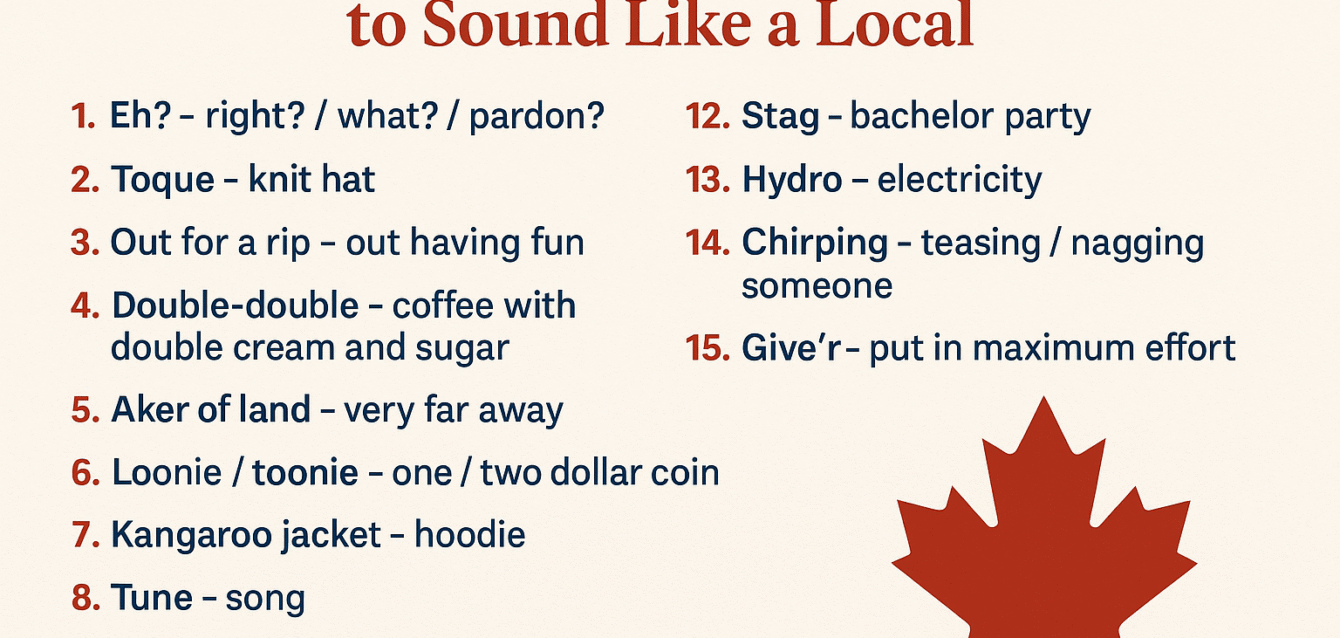
Unlock the distinct flavor of Canadian English by mastering these 15 essential idioms – complete with origins, usage tips, synonyms, and example sentences.
Why Learn Canadian Idioms?
- Cultural Insight: Idioms reflect Canada’s regional diversity – from the maritimes to the Prairies to the West Coast.
- Conversational Fluency: Native speakers pepper their speech with these expressions; understanding them keeps you in the loop.
- Memorable Language: Vivid, region-specific phrases make your English more authentic and engaging.
1. Give’r
Meaning & Origins: A popular West Coast expression meaning to give it your all or go all out.
Usage Tips: Use when encouraging maximum effort under time pressure.
Synonyms: Go for it, give it everything.
Examples:
- We’ve only got one hour to finish – let’s give’r!
- When the light turned yellow, I just gave’r and sped through the intersection.
2. Skookum
Meaning & Origins: From Chinook Jargon (BC coastal trade language), meaning strong, excellent, or impressive.
Usage Tips: Perfect for praising people or things that exceed expectations.
Synonyms: Awesome, top-notch.
Examples:
- That’s a skookum truck – it can tow anything!
- Your new jacket looks skookum, eh?
3. Chinook Winds
Meaning & Origins: Refers to the warm, snow-melting winds in Alberta; metaphorically, a sudden positive change.
Usage Tips: Use literally for weather, or figuratively for life events.
Synonyms: A breath of fresh air, turning point.
Examples:
- It was –20 °C yesterday, but a Chinook rolled in and now it’s +5 °C.
- After months of setbacks, that job offer was a real Chinook in my life.
4. Cowboy Up
Meaning & Origins: Common in rural Alberta, meaning face a challenge bravely or toughen up.
Usage Tips: Use to rally someone before a difficult task.
Synonyms: Man up, steel yourself.
Examples:
- We’ve got a big clean-up today – time to cowboy up.
- She told herself to cowboy up before the final exam.
5. Bunnyhug
Meaning & Origins: Saskatchewan term for a hooded sweatshirt (hoodie).
Usage Tips: Regional – best used in or about Saskatchewan.
Synonyms: Hoodie, hooded sweater.
Examples:
- Nice bunnyhug! Where’d you get it?
- It’s chilly out – grab your bunnyhug.
6. Grid Road
Meaning & Origins: Refers to the gravel back roads laid out in a grid pattern on the Prairies (especially Saskatchewan).
Usage Tips: Use to describe rural routes or indirect paths.
Synonyms: Gravel road, back road.
Examples:
- Take the grid road two miles, then turn left at the red barn.
- We got lost on a grid road for half an hour.
7. Keener
Meaning & Origins: In Manitoba, a keener is someone overly eager or enthusiastic – especially in school or work.
Usage Tips: Can be playful or teasing.
Synonyms: Overachiever, eager beaver.
Examples:
- She’s such a keener – always first to volunteer.
- Don’t be a keener; take it easy on the group project.
8. Double-Double
Meaning & Origins: A coffee with two creams and two sugars – iconic Tim Hortons order originating in Ontario.
Usage Tips: Ubiquitous across Canada at Tim Hortons.
Synonyms: None (distinct order name).
Examples:
- My morning routine: grab a double-double and hit the road.
- Can I get a double-double, please?
9. Hydro
Meaning & Origins: In Ontario, hydro colloquially refers to the electric utility bill (hydroelectric power).
Usage Tips: Region-specific; know your province’s power supplier name.
Synonyms: Electric bill, power bill.
Examples:
- Make sure you pay the hydro before the 15th.
- Our hydro bill was sky-high this winter.
10. Dep
Meaning & Origins: Short for dépanneur, the Québec convenience store.
Usage Tips: Common throughout Québec; may confuse non-locals.
Synonyms: Corner store, convenience store.
Examples:
- I’m heading to the dep to grab some milk.
- The dep’s open 24/7 – super handy.
11. Ça va bien aller
Meaning & Origins: French expression meaning It will be okay, seen on Québec rainbow signs during the pandemic and beyond.
Usage Tips: Warm, reassuring; ideal during tough times.
Synonyms: Everything will be fine, we’ll get through this.
Examples:
- I know it’s been rough, but ça va bien aller.
- When things get stressful, remind yourself: ça va bien aller.
12. Screeched In
Meaning & Origins: Newfoundland ceremony where visitors drink Screech rum, kiss a cod, and become honorary Newfoundlanders.
Usage Tips: Cultural rite – mention when describing travel or local lore.
Synonyms: None (unique tradition).
Examples:
- I got screeched in at a St. John’s pub last summer.
- Before you leave Newfoundland, get screeched in!
13. Stay Where You’re To Till I Comes Where You’re At
Meaning & Origins: Classic Newfoundland phrase meaning Stay put – I’ll come to you.
Usage Tips: Charming regionalism – use sparingly outside NL.
Synonyms: Hold tight; I’m on my way.
Examples:
- Don’t chase me downtown – stay where you’re to till I comes where you’re at.
- It’s a mouthful, but we love it in Newfoundland.
14. Fill Your Boots
Meaning & Origins: In Nova Scotia & New Brunswick, fill your boots means help yourself or enjoy as much as you like.
Usage Tips: Great for buffets or generous offers.
Synonyms: Dig in, help yourself.
Examples:
- The lobster feast’s on – fill your boots!
- There’s plenty of cake – fill your boots.
15. Bluenoser
Meaning & Origins: Historic nickname for someone from Nova Scotia (Bluenose was a famous NS racing schooner).
Usage Tips: Use with pride when referring to Nova Scotians.
Synonyms: Nova Scotian.
Examples:
- He’s a true Bluenoser – never misses a day on the ocean.
- We celebrated with some Bluenoser cheer at the harbour.
Practice Activities to Internalize Canadian Idioms
- Idiom Journal: Write two original sentences each day using different Canadian idioms.
- Media Immersion: Watch Canadian films or TV (e.g., Schitt’s Creek) and note every idiom you hear.
- Conversation Role-Play: Pair with a partner to act out scenarios – order a double-double, give’r on a challenge, or get screeched in.
- Flashcard Drills: Use OwnFluent’s Word Pro feature to review definitions and record your voice applying each idiom.
Take Your Canadian English to the Next Level
Mastering these idioms is about more than vocabulary – it’s embracing Canada’s rich cultural tapestry. With OwnFluent’s region-focused modules, AI-driven pronunciation feedback, and adaptive quizzes, you’ll speak – and feel – truly Canadian in no time.
👉 Start your free OwnFluent trial today and dive into immersive, Canadian-flavored English learning!