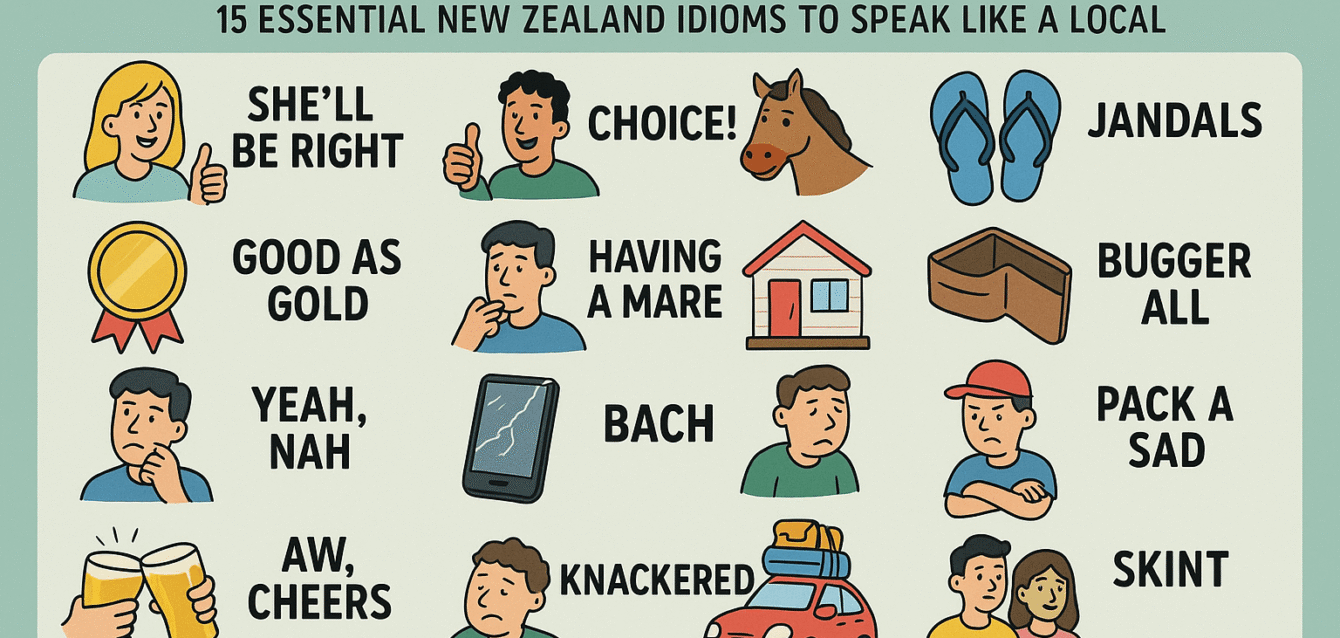
Unlock the unique flavor of New Zealand English by weaving these quintessential Kiwi idioms into your conversations. From she’ll be right optimism to hard yakka for tough work, mastering these expressions will boost your fluency, deepen your cultural understanding, and help you fit right in – whether you’re ordering flat whites in Wellington or tramping in the wop-wops.
Why Learn New Zealand Idioms?
- Cultural Connection: Idioms reflect local customs, humor, and history – key to understanding Kiwi mindset.
- Conversational Fluency: Native speakers use slang and idioms constantly; recognizing them keeps you in the loop.
- Memorable Language: Fun, vivid expressions make your speech more engaging and authentic.
1. She’ll be right
Meaning & Origins: A reassuring phrase meaning “everything will turn out fine”. Reflects the trademark Kiwi optimism – no exact origin but ubiquitous in everyday speech.
Usage Tips: Use to soothe worries or downplay minor setbacks. Best delivered with a relaxed tone.
Synonyms: No worries, All good.
Examples:
- Forgot your umbrella? She’ll be right – this shower won’t last long.
- Missed the bus? She’ll be right; another one comes in five minutes.
2. Sweet as
Meaning & Origins: Literally as sweet as honey, meaning great, perfect, or no problem. Surf and skate culture popularized the shorthand in the late 20th century.
Usage Tips: Extremely casual – ideal among friends when affirming plans or tasks.
Synonyms: Too easy, All good.
Examples:
- Can you pick up some milk on your way home? Sweet as!
- That quiz was sweet as – I breezed through it.
3. Chur
Meaning & Origins: Versatile slang meaning thanks, good, or yes. Likely influenced by Māori kōrero (to talk) and youth culture from the 2000s.
Usage Tips: Very informal – use with peers or in casual text/chat contexts.
Synonyms: Cheers, Nice one.
Examples:
- Here’s your flat white. Chur, legend!
- We’re meeting at 6 PM. Chur – see you then.
4. Keen as
Meaning & Origins: Means very eager or enthusiastic. Often extended – keen as beans or keen as mustard. Conveys excitement.
Usage Tips: Use to accept invitations or show strong interest.
Synonyms: Stoked, Up for it.
Examples:
- You keen as to go for a hike tomorrow? Keen as beans!
- She’s keen as mustard to start the project.
5. Hard yakka
Meaning & Origins: Refers to hard work or tough labour. Borrowed from Australian Aboriginal English; adopted in NZ farming and trades since the early 1900s.
Usage Tips: Emphasize physical or challenging tasks – often with a sense of camaraderie.
Synonyms: Back-breaking work, Gruelling labour.
Examples:
- Fixing that fence was hard yakka, but it’s done now.
- Sorting out the garden all day was serious hard yakka.
6. Good on ya
Meaning & Origins: A warm congratulatory phrase meaning well done. More heartfelt than a simple good job.
Usage Tips: Express genuine praise – ideal for personal or professional achievements.
Synonyms: Well played, Nice work.
Examples:
- You passed your driving test? Good on ya, mate!
- You cooked the whole roast dinner yourself? Good on ya!
7. Yeah nah
Meaning & Origins: Polite refusal or hesitant no despite sounding like yes. Common across NZ and Australia.
Usage Tips: Listen for tone – usually means no, thanks.
Synonyms: Nah, I’m good.
Examples:
- Want another slice of cake? Yeah nah, I’m stuffed.
- Heading out tonight? Yeah nah – I’ve got an early start.
8. Give it a burl
Meaning & Origins: Means give it a try. Possibly from birl (to spin), figuratively have a go.
Usage Tips: Friendly encouragement – perfect for new or daunting tasks.
Synonyms: Give it a go, Have a crack.
Examples:
- Never ridden a bike before? Nah, but I’ll give it a burl.
- That recipe looks tricky – will you give it a burl?
9. Tiki tour
Meaning & Origins: A scenic or roundabout route. Originally referred to Māori guided tours, now any leisurely detour.
Usage Tips: Use literally for travel or figuratively for wandering conversations.
Synonyms: Scenic route, Detour.
Examples:
- We took a tiki tour through Queenstown – amazing scenery.
- He went on a tiki tour explaining his plan and never got to the point.
10. Bring a plate
Meaning & Origins: Invite to bring a dish to share at a potluck. Common in backyard BBQs and community gatherings.
Usage Tips: Standard phrase in event invitations.
Synonyms: Dish to share, Potluck style.
Examples:
- BBQ at ours this Saturday – bring a plate and we’ll supply the sausages.
- For the office lunch, everyone’s bringing a plate.
11. Wop-wops
Meaning & Origins: Slang for the middle of nowhere. Likely from woop woop (Australian), embraced by rural Kiwis.
Usage Tips: Playful alternative to boonies or sticks.
Synonyms: Middle of nowhere, Back country.
Examples:
- The bach’s in the wop-wops – make sure you have full tank.
- Living out in the wop-wops has its quiet charms.
12. Chilly bin
Meaning & Origins: NZ term for a cooler or icebox. A mid-20th-century coinage combining chilly + bin.
Usage Tips: Essential term for camping, beach trips, and barbecues.
Synonyms: Cooler, Icebox.
Examples:
- Pop the drinks in the chilly bin so they stay frosty.
- Don’t forget ice for the chilli bin tonight.
13. Jandals
Meaning & Origins: Flip-flops or sandals. Derived from Japanese sandals, popular post-WWII.
Usage Tips: The default summer footwear term in NZ.
Synonyms: Flip-flops, Thongs (Australia).
Examples:
- Slip on your jandals before hitting the sand.
- I wore jandals all summer – it’s the Kiwi way!
14. Munted
Meaning & Origins: Means broken, wrecked, or extremely tired/intoxicated. In use since the 1980s.
Usage Tips: Context clarifies whether it’s physical damage or personal state.
Synonyms: Knackered (tired), Smashed (drunk), Buggered (broken).
Examples:
- My laptop’s munted after that drop.
- I was so munted after the festival I slept in until midday.
15. Stoked
Meaning & Origins: Very pleased or excited – originally surfer slang, meaning to stoke a fire of enthusiasm.
Usage Tips: Use to convey genuine excitement or satisfaction.
Synonyms: Thrilled, Pumped.
Examples:
- Just won tickets to the All Blacks match – stoked!
- I’m stoked with how my presentation went.
Practice Activities to Internalize Kiwi Idioms
- Idiom Journal: Each day, write two original sentences using different NZ idioms.
- Media Immersion: Watch Kiwi films or TV (e.g., Wellington Paranormal) and note every idiom you hear.
- Conversation Role-Play: Team up with a language partner and act out scenarios – inviting them to bring a plate or planning a tiki tour.
- Flashcard Drills: Use OwnFluent’s Word Pro feature to review definitions and record your own voice applying each idiom.
Take Your Kiwi English Further
Mastering New Zealand idioms is about more than just vocabulary – it’s embracing local culture and mindset. With OwnFluent’s region-specific modules, AI-driven pronunciation feedback, and adaptive quizzes, you’ll speak – and think – like a true Kiwi in no time.
👉 Start your free OwnFluent trial today and dive into immersive New Zealand-focused content designed to make you feel right at home.